FinanceAITomorrowX 2026November 2026
Blackstone’s Jon Gray at TomorrowX: AI’s Blue-Collar Boom, the “Electrification of Everything,” and How to Spot a Bubble
In conversation with Valor’s Antonio Gracias, Blackstone’s President and COO talked about growing up in suburban Chicago, why AI is creating jobs in the physical world, how AI is changing cancer research for his family, and the three conditions that signal a bubble.
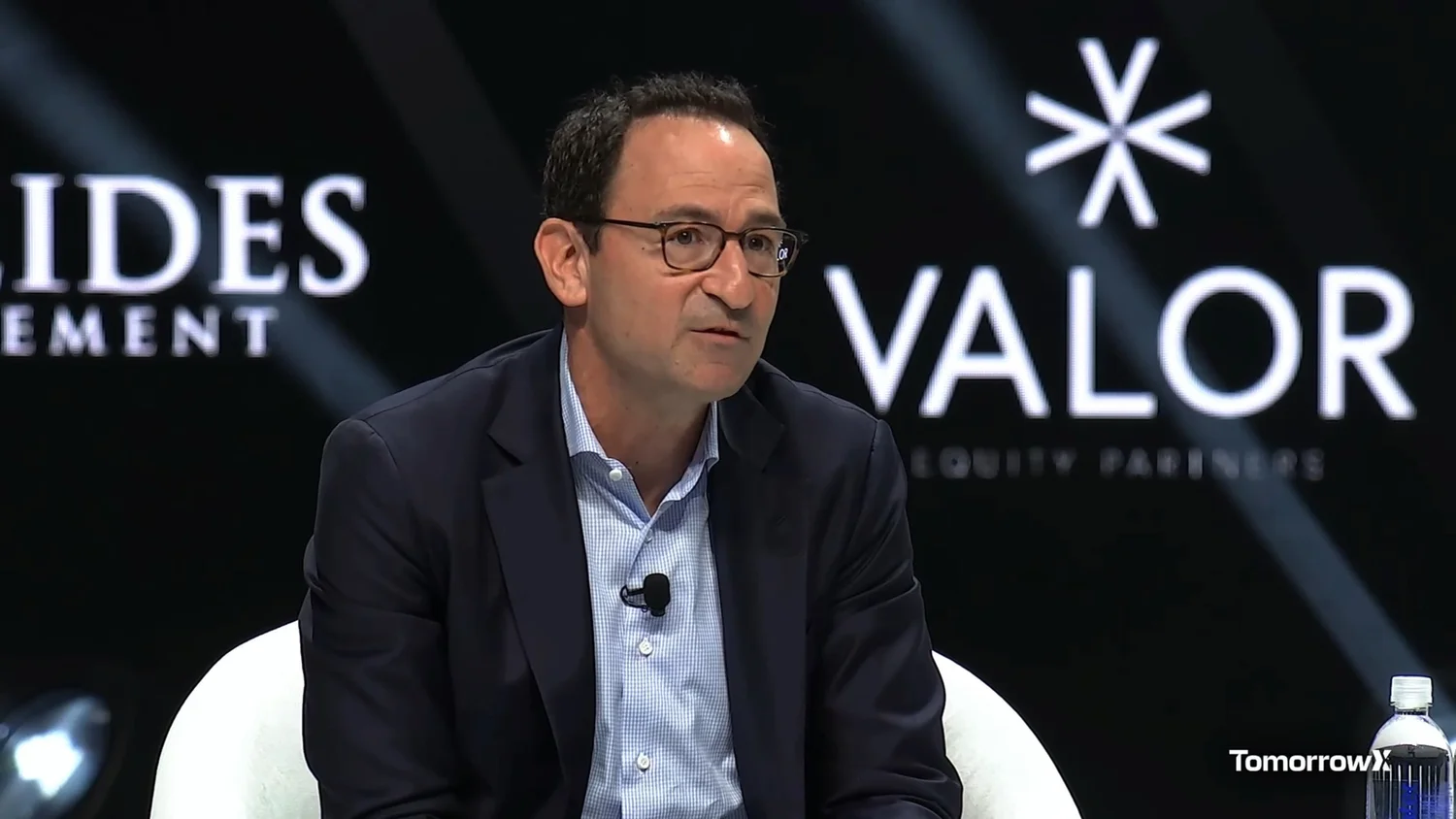
AUSTIN On the second morning of TomorrowX, Blackstone President and COO Jon Gray sat down with Valor Equity Partners founder Antonio Gracias on the Main Stage. The conversation covered the massive physical buildout behind AI, but Gray kept returning to the people on the other end of it: the communities, workers and families who have to come out ahead.
“Now, that’s American dream”
Gracias opened by asking Gray to share his story.
“I grew up in suburban Chicago. I went to college at the University of Pennsylvania,” Gray said. “When I got there, I made one really good decision to get a dual degree. In my senior year, I met a young woman. I got a job working at a very small investment advisory firm in New York.”
“35 years later, I’m with the same woman, and I’m working at the same firm.”
“Now, that’s American dream,” Gracias said.

Giving back to the communities that host the buildout
Gray said Blackstone is thinking about the AI buildout at the level of the individual community, starting with the electricity bill. On one large data center project, he said, the firm expects to “give back what’s estimated $1.75 billion to consumers.”
“We just gave, as part of an energy project we’re building for a data center in Wyoming, $105 million to Yellowstone National Park,” he said, “the largest gift ever to a federal park.”
He added that Blackstone is “working very closely with the labor unions on all of this. We formed partnerships with them. There is an opportunity to make sure many people win.”
A blue-collar job boom
Asked how AI is changing everyday lives today, Gray pointed to jobs. “There was rightfully a lot of concern about jobs,” he said. “What we’re seeing at our companies, their employment growth in the US is up 3%.”
“The biggest increase is in the physical world. It’s building the energy. It’s building the data centers.”
Gracias raised the anxiety he’d heard from students training for entry- and mid-level white-collar jobs. Gray’s answer was measured optimism: “Technology often proves to be much more empowering than we realize, and it’s hard to figure out what kind of opportunities the technology’s gonna create.”
“One very encouraging thing we’re seeing, new business formation is at record levels,” he said. “Even traditional knowledge work, these become tools to make people superhuman.”

Picks and shovels: the “electrification of everything”
Blackstone’s biggest AI bet starts with power. “We like to think about being part of the entire ecosystem, which starts with the energy and power, with those electrons,” Gray said.
“Everything you’re talking about here, the AI, the autonomous vehicles, the robots, it’s all gonna need electricity. So betting on the electrification of everything, to us, seems like a really smart way to play the picks and shovels of this technological revolution.”
“Data centers has been our biggest area of concentration,” he said, along with financing the infrastructure and the chips. “Being the infrastructure provider in a world that is short of compute makes a lot of sense, and the shakeout in markets may result in fewer players who have capital to do this.”
A personal mission
When Gracias asked what Gray is doing personally to advance humanity, the answer was close to home. “We lost my wife’s sister, Faith Basser, to a BRCA-related cancer,” Gray said. BRCA mutations carry a much higher risk of breast and ovarian cancer in women, and affect men as well.
“The challenge has been the amount of data that you have to crunch,” he said. “What AI enables us to do, where we’re tracking BRCA-positive people, it’s enabling us to look in a way that was never possible.”

Three signs of a bubble
With so much capital flowing into AI, the bubble question was inevitable. Gray laid out how he thinks about it.
“One is excessive valuations. Another condition that often exists is speculative building. And the third thing I’d say is often you have excessive leverage when you have a bubble.”
The takeaway
Gray’s case for AI is grounded in the physical world: power plants, data centers, electricians and construction crews, and the communities that host them. Thirty-five years after walking into a small New York firm, he described an AI economy where, in his words, there is “an opportunity to make sure many people win.”
 More from TomorrowXElon Musk at TomorrowX: AI Must Be “Maximally Truth-Seeking”
 More from TomorrowXThe Women of TomorrowX: Lin Qiao and Laura Harrison
 More from TomorrowXTomorrowX Day 1: An AI Boom, Bubble Talk, and Compute in Space
 More from TomorrowXTokens Are Dirt: Arm, Micron, CoreWeave, Cerebras and The Boring Company on Building AI’s Physical World
← All coverage