AIFuture of WorkMoment 2026October 2026
"Every Deployment Is the Next Sale": Anthropic's Rob Hardy on What Forward-Deployed Engineering Really Is
At Moment 2026, Anthropic's Global Head of Forward Deployed Engineering explained why the line between pre-sale and post-sale is disappearing, why the interface is no longer the moat, and why the winners won't be the companies with the most engineers.

NEW YORK Every major cloud and AI company seems to be announcing a forward-deployed engineering team, often with a nine- or ten-figure investment attached. Rob Hardy, who leads forward-deployed engineering at Anthropic, told a room of customer success leaders at Moment 2026 that almost no one is defining what the job actually is. So he did.
In Hardy's telling, forward-deployed engineers sit with a customer, build the thing, ship it to production and own whether or not it works. Then comes the part he called the most critical: they take what they learned back to the product and research teams, so the next customer starts further ahead.
The pre-sale, post-sale line is disappearing
Hardy opened with a shift most people in the room could feel. In a traditional software business, the account executive closes the deal and hands it off, and the post-sale team handles deployment and renewal. In a consumption-based business, he said, that split stops making sense. Every bit of value delivered is the revenue, and if usage doesn't grow, there's no revenue. Everyone, in effect, is now in sales.
"A lot of us built our careers around being the people who make it work after the sale. And that job's not going away. It just starts a lot earlier and it never stops."
At the same time, products are going "headless." With MCPs and agents acting on a user's behalf, he said, "a lot of folks aren't hitting the interface at all." An agent calls a product as a tool, gets what it needs and moves on. For many software companies, the interface was the moat. If it stops being the moat, Hardy said, the question becomes: "What is a vendor actually worth?"
The unit of work keeps getting bigger
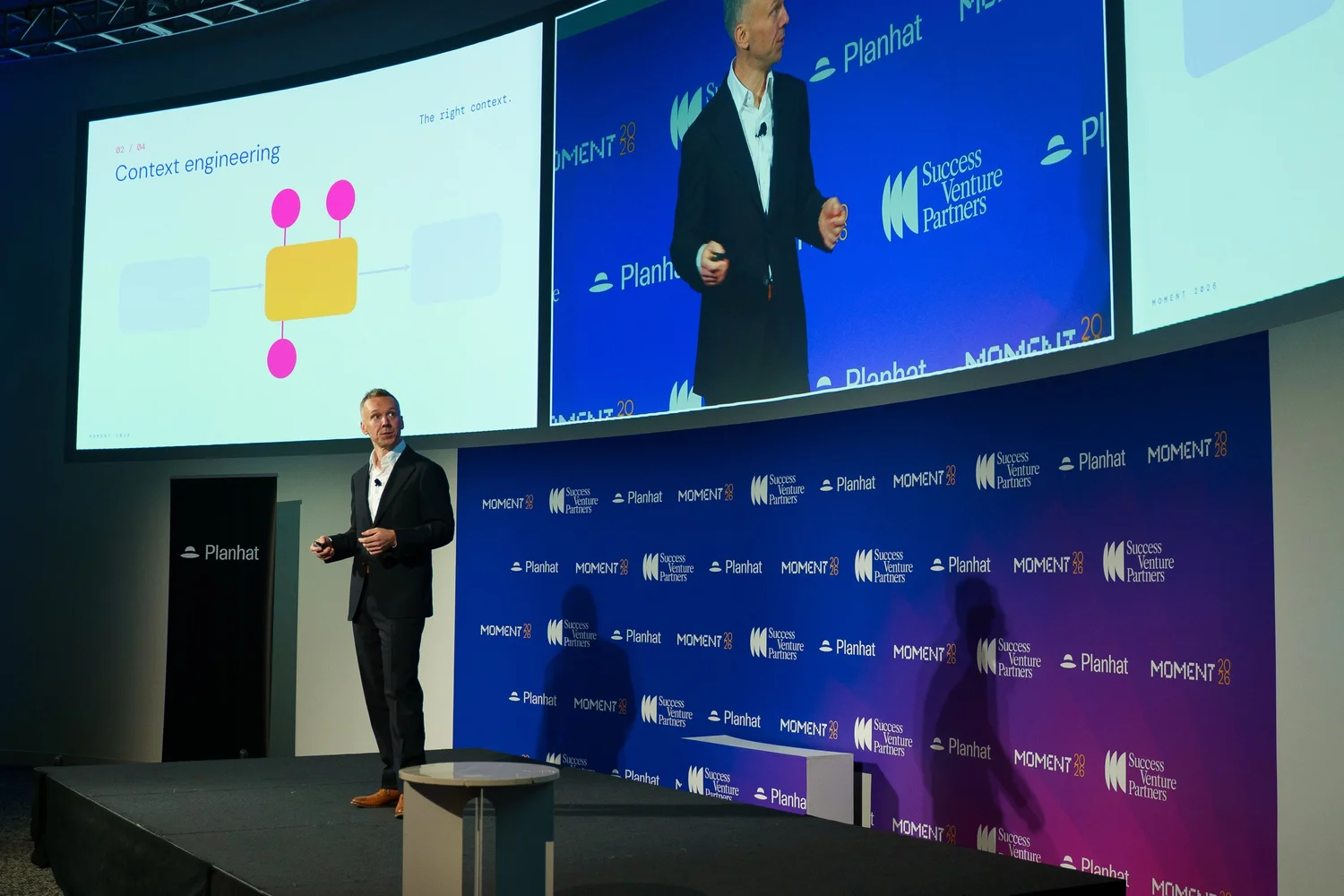
To show how the job has changed, Hardy walked through a process almost everyone has suffered through: an insurance claim. A couple of years ago, AI meant prompt engineering, one task at a time, like asking a model to summarize a claim for an adjuster. Then came context engineering, giving the model the policy documents, claim history, damage photos and call center notes it needs. Then agents that draft a decision, check it against the policy, and retry or hand off to a human. Now, he said, the work is designing how intake, fraud review, adjudication and payment move through an entire business, with humans in the loop where they're needed.
Each step zooms out, and "the unit of work just gets bigger." At that level a clever engineer isn't enough. You need someone who understands how the claims process actually runs, which, he noted, is what the best people in the room have been doing for years.
Find it, prove it, publish it
Anthropic's ratio of forward-deployed engineers to customers, Hardy said, is orders of magnitude off from a traditional software services model. Every customer the team chooses to support means others are left waiting. Embedding engineers in a handful of big accounts would make the team the bottleneck. So the team works in three steps: find the use cases that are both valuable and needed by many companies, prove them in production, then publish what they learn.
"It's not a POC. It gets to production with real users, real data, and all of the ugly edge cases that only show up when real people are using something at the volume that we're talking about here."
His example was a project with one of the largest retailers in the world, which he couldn't name: an agent in front of the store helping shoppers search, compare, buy and get support in plain language, and one behind the counter helping merchants with insights, inventory, pricing and promotions. Getting it to production meant working through rough edge cases. Then the team did something he said a typical services group wouldn't do. "We didn't write a case study, we published a blueprint." The open-source repo includes the harness, the evals and the prompts, and Anthropic trained its systems integrator partners to support it. One deployment has since grown into examples across retail, travel, telecom and entertainment. "This is essentially how our relatively small team reaches and has impacted thousands of customers," he said.
"We don't have it figured out perfectly"
Hardy said his executive briefings with customers often feel like therapy sessions. The C-suites he meets are terrified of moving too slowly and becoming irrelevant, and terrified of moving too fast, because many are systemically important banks or utilities where a mistake means real economic harm and a headline. His honest answer to them is that no one has it figured out.
"Not one of our customers has it figured out perfectly. And just by being honest, we don't have it figured out perfectly."
That, he argued, is the opening. When everyone is figuring it out at the same time, "the most trusted advisor is going to be the one that wins." Sometimes that means telling a customer they don't need the biggest model for a job and losing a sale, in exchange for the strategic partnership that he said will be "significantly more valuable." When the product is an agent working across a customer's business, he said, "understanding that business isn't nice to have. It is literally the entire thing."
Three things to do on Monday
- Be a consultant in your vertical"The product is kind of becoming plumbing in a lot of cases. The expertise is actually what customers might be paying for." Anthropic's forward-deployed engineers include medical doctors with years of clinical research experience. The skill set isn't hand-coding; he noted that Anthropic's own engineering team "barely codes at all anymore." His test: could someone on your team draw your five most strategic customers' core business processes on a whiteboard from memory, and point to where your product changes them?
- Build primitives, not playbooksNo two customers look the same, so build composable pieces: templates, architectures, evals. When someone solves something hard for one customer, make it someone's job to turn it into a piece the next team can use, or it will get pushed to next week forever.
- Every deployment is the next saleLook hard at how you staff, pay and measure teams that are split into pre-sale and post-sale. The best measure is outcomes in production: "Is it running in production? Is it making the customer's business better?"
He closed by saying the winners of the next era "won't be the companies with the most engineers building the most things." They'll be the ones who understand the whole map of a customer's business. "We're never going to outhire this problem," he said. "And honestly, I think that's good news."